In Their Own Time: Precarious and unpaid work in higher education
Casualisation – the precarisation of work, in which core business previously done by colleagues on open-ended contracts is done on hourly, fixed-term, sessional, and one-off basis – is a key feature of the contemporary academic workplace. In this EDICa-funded co-participatory project In Their Own Time: challenging conventional funding structures to include intersectionally underrepresented casualised academics, we examine the invisibilised and unpaid work expected by intersectionally marginalised long-term casualised academics: the hoops of research funding, the lack of institutional support, the intrinsic ableism of neoliberal academia, and exclusionary processes.
We examine how the expectations of unpaid labour are particularly discriminatory towards colleagues with caring responsibilities, whose ‘own time’ is ‘other people’s time’ and/or disabled individuals whose ‘own time’ is often ‘recovery time’. The normalisation of such exploitative expectations creates a system where career progression or maintenance is skewed in favour of those who can work beyond their paid hours. Such exclusionary practices mean that academia becomes, or rather remains, a place of inequality where only the privileged few can afford to stay.
Sharing the stories of eight intersectionally marginalised insecurely employed academics, this project shows how current eligibility criteria imposed by funders and implicit expectations of unpaid labour disadvantage these groups, which are underrepresented among research funding award holders.
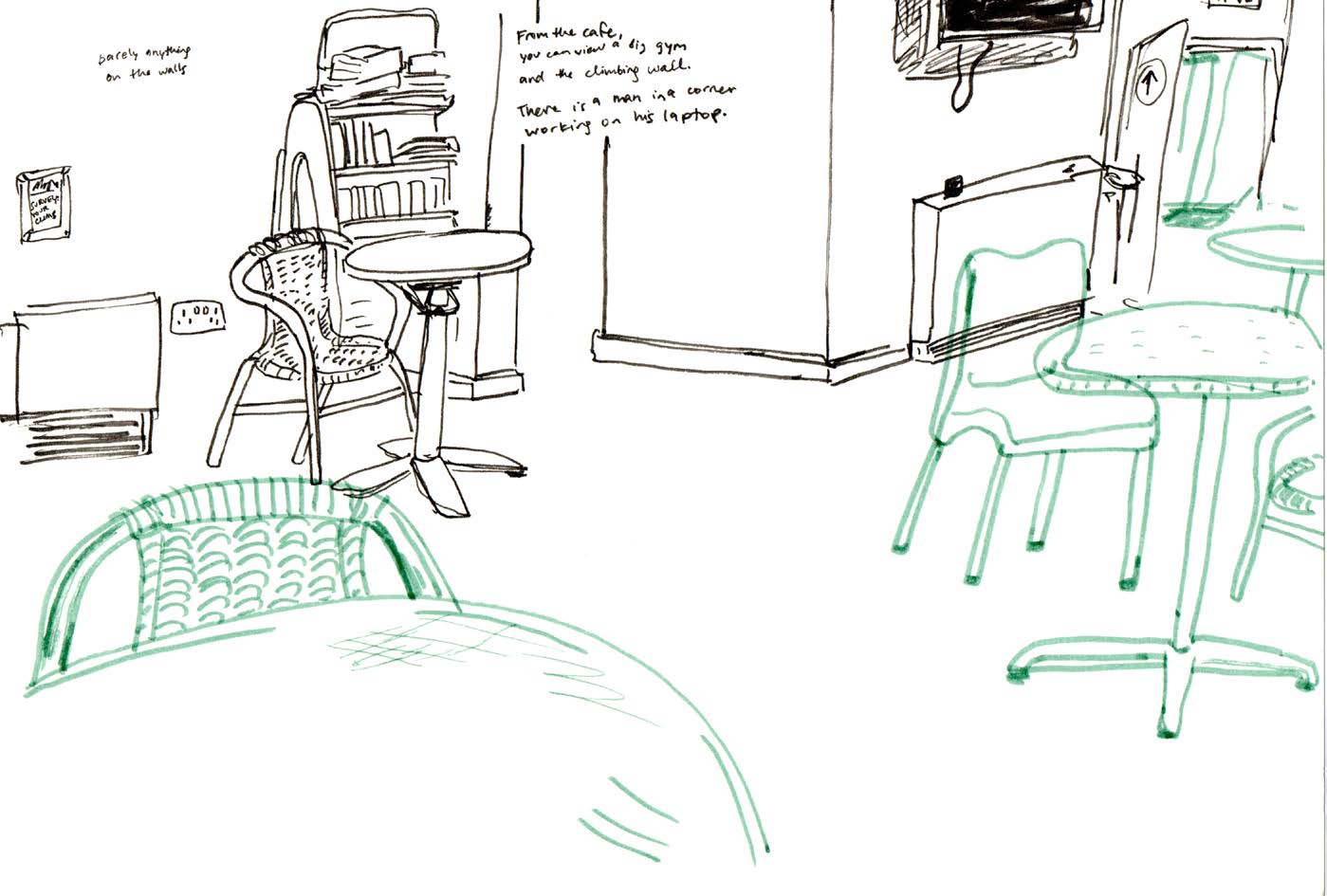
Participants in this project, lacking office space, often work from unconventional places – like this gym cafe.
The extent of casualisation in UK higher education
While a generation ago many colleagues in higher education considered a period of casualisation a ‘rite of passage’ or a necessary career ‘stage’, job insecurity is now the norm, and a form of working condition rather than a ‘stage’ in an academic career (Menard and Shinton 2022; Bonello and Wånggren 2023). The scale of casualisation is staggering: across UK institutions, 74 percent of teaching staff are employed on hourly or fixed-term contracts, while 65 percent of research-only and 13 percent of academic-related professional staff are on fixed-term contracts. These numbers are greatly underestimated, in part because thousands more staff are employed on fixed-term contracts disguised as open-ended ones, bearing names that are contradictory in terms (e.g. ‘open-ended with review or at risk date’, ‘open-ended fixed-term’, ‘finite-funded permanent’). These contracts exist to satisfy government regulations requiring temporary staff with over four years of employment to be made permanent (Gov.uk, n.d.), but offer no real job security. On the other hand, employers benefit by appearing as good employers when official UK higher education employment statistics (HESA 2025) misleadingly count these positions as open-ended. In addition to the above numbers, there are over 62,000 ‘atypical’ casualised workers (UCU 2025). Indeed, in the UK, higher education is the second most casualised sector after hospitality (ONS 2023).
Importantly, casualisation does not hit equally: statistics show that racially minoritised and women workers, especially intersectionally marginalised individuals, are more likely to be employed on insecure contracts in higher education (UCU 2025), as are disabled and ill academics (Brown and Leigh 2018). In addition, intersectionally marginalised individuals experience precarity more acutely (O’Keefe and Courtois 2019; Myers 2022; Evans et al. 2024). For instance, Asian women are nearly twice as likely as white men to be employed on fixed-term contracts, with almost half of Asian women in such roles compared to just over a quarter of white men. Black academics, meanwhile, are disproportionately represented in the most exploitative contracts, that is zero-hour and hourly contracts (UCU 2020). In the most recent Higher Education Statistical Agency (HESA) statistics, we see racialised patterns: for academic hourly paid staff, 25 percent are Black workers, while 14 percent are White workers, 15 percent Asian and 17 percent ‘Other’ (including mixed) workers (UCU 2025). Casualisation is an equalities issue, as much as it is a wider issue of job security. It is also, as our project shows, a question of unequal and exclusionary research cultures and funding processes, which needs addressing.

One participant, who lives with chronic illness, primarily works from their bed using a portable table.
Exclusionary research cultures
I’m moved,
that my time is
valued like this.
Participant, reflecting on being paid for this project

Despite recent efforts to promote a more diverse and inclusive research culture (e.g. Royal Society 2019; Wellcome 2020; UKRI 2024), long-term casualised academics still face significant obstacles that hinder their career progression and perpetuate cycles of marginalisation (Menard and Shinton 2022). Around two thirds of research staff in UK higher education are employed on fixed-term contracts, some less than a year in length (UCU 2023). Although they are estimated to represent approximately one third of the research staff population (Mellors-Bourne and Metcalfe 2017), long-term casualised academics and the obstacles to their career progression have been overlooked. These academics do not fit within the traditional PhD-Early Career Researcher-Lectureship career structure; indeed the term ‘early career’ researcher (ECR), which is often used to describe academic staff who have not ‘yet’ secured lectureships, is a misnomer masking structures of exploitation in higher education (Menard 2022; Bonello and Wånggren 2023).
While women and racially minoritised academics are overrepresented among academics in insecure contracts (UCU 2025), and disabled women and those with caring responsibilities are overrepresented among long-term casualised academics (Menard and Shinton 2022), these groups are underrepresented among award holders. Our co-participatory project examines how academic staff on insecure contracts, many of whom are women and racially minoritised groups, are often expected to apply for the grants necessary for career progression ‘in their own time’. This exclusionary expectation particularly disadvantages those who have extra demands on their time and who cannot exceed their working day beyond their contracted hours, including women in part-time roles and/or with caring responsibilities or disability. Sharing the stories of eight casualised academics, this project makes visible how current funding structures, expectations of a linear career, and gendered and ableist expectations of unpaid labour hinder access to career progression opportunities.
Visibilising inequality
Through sharing the experiences of intersectionally marginalised members of groups disproportionally represented among long-term casualised academics, this project sheds light on the invisibilised labour, time required and expected, and obstacles encountered by such groups before and during the grant-writing process, in this way revealing exclusions inherent in conventional funding structures. Crucially, precarity does not concern only our working lives; the insecurity it brings spreads into all areas of life and hinders health, family planning, life choices, and living situation.
The participants on this project tell stories of combining paid and unpaid work, visa applications, health issues, and a range of insecure jobs. They show how the expectation of work ‘in their own time’ is particularly damaging for those who often have extra demands on their time, including for many disabled persons and those with caring responsibilities. Steph, a single mum who juggles housework, childcare, and two insecure jobs, states: ‘Every year I panic – am I going to have a job this year?’ What she calls her ‘own time’ is at night when she does emails for her jobs, after her child has gone to bed. Our participant Chris remarks that ‘The university runs on good will, it runs on everyone doing things in their own time’. Susie, a casualised researcher since 20 years, also remarks on the expectation of working unpaid in academia, for example applying for funding in her own time even when not paid for it; non-academic colleagues think ‘it’s crazy’ but in academia it is normalised. She highlights that not everyone can work for free – with childcare responsibilities, she needs flexibility. Alex is a disabled academic, whose disability has been made worse by precarity. Another participant, Eimhir, explains that she spends her own time managing her chronic health condition alongside paid work, and cannot fit in further unpaid academic work even if this is required to succeed in the university. Olivia, a mum and researcher, keeps her work with her all the time – including when marking dissertations by the pool when the kids are at swimming lessons on Saturday morning. Meanwhile, Gwen is a trans academic in multiple precarious part-time jobs: she gives lectures, does research, organizes events, and supports her colleagues unpaid in her spare time. Like many migrant academics, our participant Robbie’s anxiety around what the next job will look like is exacerbated by his status as a migrant on a visa.
The pressure to secure external funding is pervasive within academia, yet for those employed on casualised contracts that do not include research or grant writing in their job specifications, the implicit assumptions that grant writing and other career-advancing activities can be done in one’s ‘own time’ becomes a significant barrier to career progression. In addition, many opportunities are advertised to ‘early career’ or ‘mid-career’ researchers, spaces that long-term casualised academics are often excluded from because of eligibility criteria or normative expectations of achievements. These expectations do not reflect the lived experience of individuals in intersectionally marginalised groups who cannot engage in career-advancing pursuits, such as grant writing, ‘in their own time’. By examining and amplifying the voices of those affected, our project visibilises structures of inequality in research funding.
Fund research, not inequalities
All those involved in the project have lived experience, as casualised academics at the intersection of inequalities, of being marginalised in research funding processes. As precariously employed academic workers who wrote this project proposal unpaid and in our own time, in our homes and in cafes, we call on employers and funders to address fully the methodological and political concerns arising with workload, job insecurity and other forms of precarity, critically questioning the ways in which we do academic work. As seen in our project, the reliance on intersectionally gendered unpaid labour creates further inequalities, and it excludes those whose own time is other people’s time.
Through our project, we shine a light on the unpaid invisibilised work demanded of us in our own time, making visible the ableist, ageist, racist and sexist structures and harms of the neoliberal university. We thanks our fantastic participants for their words, labour, time and solidarity, and we demand change. If you – the person reading this – are involved in university management, research cultures and funding processes, we ask that you listen to the experiences of the participants and take action to create more inclusive research and funding structures.
References
Bonello, M., and L. Wånggren. 2023. Working Conditions in a Marketised University System: Generation Precarity. Palgrave Macmillan.
Brown, N., and J. Leigh. 2018. Ableism in academia: where are the disabled and ill academics? Disability & Society 33(6): 985–989.
Evans, B., A. Allam, A. Bê, C. Hale, M. Rose, and A. Ruddock. 2024. Being left behind beyond recovery: ‘crip time’ and chronic illness in neoliberal academia. Social & Cultural Geography, Ahead-of-print: 1–21.
GOV.UK. n.d. www.gov.uk/fixed-term-contracts/renewing-or-ending-a-fixedtermcontract.
Higher Education Statistical Agency (HESA). 2025. Data and Analysis: Employment Conditions. www.hesa.ac.uk/data-and-analysis/staff/employment-conditions.
Mellors-Bourne, R. and J. Metcalfe. 2017. Five Steps Forward. Vitae. https://www.vitae.ac.uk/news/vitae-news-2017/five-steps-forward. Accessed 3/5/2024. Internet Archive. https://web.archive.org/web/20240627031714/https://www.vitae.ac.uk/news/vitae-news-2017/five-steps-forward
Menard, C. 2022. What’s in a name or why terms like ‘ECR’ can be alienating. https://blogs.ed.ac.uk/iad4researchers/2022/07/04/whats-in-a-name-or-why-terms-like-ecr-can-be-alienating/.
Menard, C. B. and S. Shinton. 2022. The career paths of researchers in long-term employment on short-term contracts: Case study from a UK university. PLoS ONE 17(9): e0274486.
Myers, M. 2022. Racism, zero-hours contracts and complicity in higher education. British Journal of Sociology of Education 43(4): 584–602.
O’Keefe, T. and A. Courtois. 2019. ‘Not one of the family’: Gender and precarious work in the neoliberal university. Gender, Work and Organization 26(4): 463–479.
Office for National Statistics (ONS). 2023. www.ons.gov.uk/employmentandlabourmarket/peopleinwork/employmentandemployeetypes/adhocs/1494employmentbyindustrydivisiongroupandclassandwhetherjobispermanentortemporaryuk2007to2022
Royal Society. 2019. Research Culture: Changing expectations. https://royalsociety.org/news-resources/projects/research-culture/changing-expectations/.
UKRI. 2024. Research and innovation culture. www.ukri.org/what-we-do/supporting-healthy-research-and-innovation-culture/research-and-innovation-culture/.
University and College Union (UCU). 2020. Precarious work in higher education. Insecure contracts and how they have changed over time. www.ucu.org.uk/media/10899/Precarious-work-in-higher-education-May-20/pdf/ucu_he-precarity-report_may20.pdf.
University and College Union (UCU). 2023. Support for Research Staff 2023. www.ucu.org.uk/media/14251/FOI-2023—support-for-research-staff/pdf/UCU_HE_FOIs_-_research_staff_support_Dec_23.pdf.
University and College Union (UCU). 2025. Precarious work in higher education – update February 2025 (HESA staff data 2022/23). www.ucu.org.uk/media/14814/Precarious-work-in-higher-education—update-February-2025/pdf/HESA_-_Precarious_work_in_HE_22-23_-_Feb_2025.pdf.
Wellcome. 2020. Research culture: let’s reimagine how we work together. https://wellcome.org/what-we-do/our-work/research-culture.